

Dry Shotcrete Machine
About us
Henan Tytion Machinery Co., Ltd was established in 2003. Now it owns total assets over 3 million RMB with 90 staff including 20 professional technicians and 12 engineers. Engineers with the college degree take up more than 70% of the total staff number. The company has new modern standard workshop of 16,000 m². Henan Tytion Machinery is a professional construction machinery manufacturer integrating design, research and development, production and sales. The company is located in Zhengzhou City, Henan Province, with convenient transportation. The company mainly produces various types of grout pumps, dry and wet shotcrete machine, small drilling rigs and other construction equipment, and its products have been well received by customers.
With the company's foundation laid, under the guidance, supervision and strict requirements of the leaders, and with the active coordination and cooperation of colleagues from various departments, the company has achieved remarkable results in the past few years. It has successfully opened up markets in Southeast Asia, Africa, South America, the Middle East and other countries and regions. In the future development process, we will always based on integrity and guaranteed by technology, we sincerely serve every customer.
Why choose us?
Professional manufacturer
Henan Tytion Machinery is a professional construction machinery manufacturer integrating design, research and development, production and sales.
Customized services
Design and manufacture machines for you as your special requirements, provide you with project, process design, and purchase program.
Quality assurance
All of our products comply with international quality standards and are greatly appreciated in a variety of different markets throughout the world.we have received ISO9001 certificate,CE certificate, etc.
Rich experience
Dedicated to strict quality control and attentive customer service, our experienced staff is always available to discuss your requirements and ensure complete customer satisfaction.


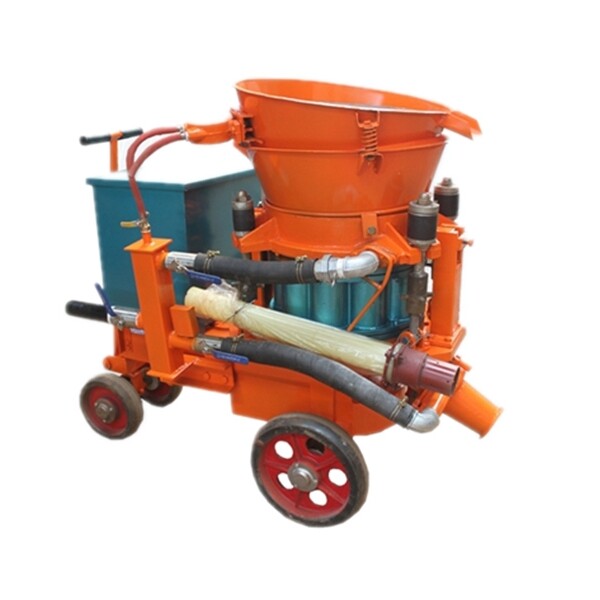
Dry shotcrete machines are also known as gunite machines. These machines use a pre-mixed dry mixture of cement and aggregates that are fed into a hopper. The dry mixture is then propelled through a hose by compressed air to a nozzle where water is introduced to wet the mixture before it is sprayed onto the surface.
Dry shotcrete machines are typically used in applications where the thickness of the shotcrete layer is relatively thin and the surface is relatively flat. Dry mixes are ideal for applications requiring high strength, dense shotcrete layers, such as the construction or rehabilitation of retaining walls, ponds and other structures.
Advantages of Dry Shotcrete Machine
High work efficiency
Dry mixes are easier to handle, transport and store. Dry mix is also more resistant to the effects of moisture, which means it can be stored for longer periods of time without losing its strength or consistency.
Less rebound
Rebound is the amount of shotcrete that bounces off the surface being sprayed and is wasted. Dry shotcrete machines produce less rebound because the dry mix adheres better to the surface being sprayed, reducing the amount of material that bounces off.
Density
Employing the shotcrete method properly ensures the concrete will be compact and durable. The high velocity at which the mixture is sprayed drives particles into every crevice on the receiving surface, resulting in a mass typically more durable and long-lasting than other methods can provide.
Versatility
Shotcrete is used for reinforcing excavations, lining inside tunnels, mines, and subways, and for theme parks, skate parks, and retaining walls. Limitations when using other methods, like shape, size, depth and style, do not exist with this one. This allows its employment for decorative projects as well, while still ensuring strength, durability and longevity. Shotcreting’s unlimited customization potential makes it popular with forming pools, retaining walls and faux finishes, and constructing high-rise facades.
Usage of Dry Shotcrete Machine
Bridges
Dry shotcrete machine can be used for bridge deck rehabilitation, but it has generally been uneconomical for major full-thickness repairs. It is very useful, however, for beam repairs of variable depths ,caps, columns, abutments, wing walls, and under decks from the standpoint of technique and cost.
Buildings
In building repairs, dry shotcrete machine is commonly used for repair of fire and earthquake damage and deterioration, strengthening walls, and encasing structural steel for fireproofing. The repair of structural members such as beams, columns, and connections is common for structures damaged by an earthquake.
Marine structure
Damage to marine structures can result from deterioration of the concrete and of the reinforcement. Damaging conditions are corrosion of the steel, freezing and thawing action, impact loading, structural distress, physical abrasion from the action of waves, sand, gravel, and floating ice, and chemical attack due to sulfates.
These problems can occur in most marine structures such as bridge decks, piles, pile caps, beams, piers, navigation locks, guide walls, dams, powerhouses, and discharge tunnels. In many cases, dry shotcrete machine can be used to repair the deteriorated surfaces of these structures.
Spillway surfaces
Surfaces subject to high velocity flows may be damaged by cavitation erosion or abrasion erosion. Dry shotcrete machine repairs are advantageous because of the relatively short outage necessary to complete the repairs.
Underground excavation
For the most part, dry shotcrete machine is used in underground excavations in rock; but on occasion, it has been successfully used in the advancement of tunnels through altered, cohesion-less, and loose soils.
Typical underground shotcrete applications range from supplementing or replacing conventional support materials such as lagging and steel sets, sealing rock surfaces, channeling water flows, and installing temporary support and permanent linings.
Slope and surface protection
Dry shotcrete machine is often used for temporary protection of exposed rock surfaces that will deteriorate when exposed to air.
Dry shotcrete machine is also used to permanently cover slopes or cuts that may erode in time or otherwise deteriorate. Slope protection should be properly drained to prevent damage from excessive uplift pressure.
Application of shotcrete to the surface of landfills and other waste areas is beneficial to prevent surface water infiltration.
1.Clean the surface before spraying
In order to prepare the substrate in underground applications, the first step is to evaluate the risk of falling rock and loose material. All loose material and debris has to be removed, and the substrate has to be cleaned from dust, using water, air or a combination of both.
2.Maintain a distance of 1 to 2 m between the nozzle and the substrate
The impact force which guarantees the adhesion of the shotcrete to the surface is determined by the distance between the nozzle and the substrate. A distance too short results in a high quantity of rebound. With a distance too great, the impact force is too weak to provide proper adhesion and compaction of the shotcrete.
3.Place the nozzle at an angle of 90° to the substrate
The angle between the nozzle and the substrate influences the correct compaction of the shotcrete and the quantity of rebound. Besides, the spraying has to be carried out in circular movements evenly over the whole surface to achieve a homogenous result.
4.Fill holes and cracks
Before applying the first layers, it is necessary to even out the substrate by filling holes and cracks of the terrain.
5.Application in layers
Layers should be applied beginning from the bottom of the surface continuing upwards. The first layer serves as excavation support and as adhesive bridge for the following layers . The number and thickness of the remaining layers depend on the jobsite requirements and the desired homogeneity of the finish.
6.Clean the surface after longer breaks between the application of layers
If too much time between the application of one layer and another one passes, it is recommendable to clean the surface with water, air or both, in order to eliminate dust and to facilitate adhesion to the surface.
7.Clean the Dry Shotcrete Machine immediately after the application
An essential part of the correct maintenance and cleaning of the equipment is preventing any accumulation of material in the hoses, nozzle, concrete pump and additive pump to avoid an increased discontinuity of the flow and guarantee smooth operation. The application can only begin anew with properly cleaned equipment.
8.Hydrate the surface
Recommends maintaining the surface moist for at least 7 days after the application, in order to prevent loss of compressive strength and the appearance of cracks caused by the fast hardening of the sprayed concrete. This process is called curing.
Methods include the sprinkling or spraying of water over the surface, the use of paper or plastic covers and sheets or adding specific additives to the concrete mix.
9.Continuous operator training
The operator will achieve the best results of the application if kept up to date about all details concerning shotcrete: efficient use of concrete spraying equipment, correct shotcrete mixture (composition, preparation and application) and spraying techniques.
How to Maintain Dry Shotcrete Machine
Concrete pump
In the concrete pump you’ll find the water box. This box must always be filled with clean water, as it contains the cylinder rod, which must be kept cold.
Besides this, the box performs other important functions. For example, if you see that there are remnants of concrete present, this indicates that the concrete cylinder pistons have leaked and that you need to replace them. If you see that there’s oil, however, it means the leak is coming from the hydraulic cylinders. Hence the need to keep the water box clean – doing so means you will be made aware should problems arise in the pump’s cylinders.
To fill the water box, symple use a hose. In situations of extreme cold, antifreeze may need to be added to the water.
Greasing system
This system is responsible for ensuring that both your pump and spraying arm are greased properly – with a little help from you, of course.
Regardless of whether your pump boasts an automatic or manual greasing system, you will need to make sure that all nipples have been greased. Because you know it: a well-greased pump is of vital importance to the proper functioning of the pumping system.
As for the spraying arm, it may be greased manually or automatically, depending on your equipment. This gesture will extend the lifespan of your spraying arm, as well as allow for smoother movements.
Remote control
Mechanized equipment without a properly functioning remote control leaves a lot to be desired. With this inspection, you’re out to make sure that the various functionalities of the remote (radio/cable) are up and running.
Hopper
The important thing here is to make sure that the grill and hopper are clean, and that the vibrator is in working order, as the latter allows the concrete to flow when poured. It is equally important that the hopper is kept clean, given that, when remnants of concrete stick to the S tube and the wear plate, the machine can fall victim to premature wear and tear – something that should be avoided at all costs.
Air and additive system
With this inspection, you’re out to make sure that the diffuser holes, the nozzle, and the air and accelerator lines are free of obstructions, as this negatively impacts the quality of the concrete. As we saw not long ago in this post, a comprehensive cleaning of your mechanized shotcrete equipment is vital after each spray, in order to ensure its proper functioning.
Delivery pipes and hoses
Before each spraying job, it is imperative that you lubricate the concrete circuit, which is made up of delivery pipes and hoses. If this lubrication process is omitted, the pipes and hoses end up absorbing part of the grout as the concrete passes through, which can alter the quality of the mix and produce blockages. The longer the delivery pipes and hoses, the greater the need to lubricate.
How to Choose the Right Dry Shotcrete Machine
Construction requirements
Clearly define the specific requirements of the construction project, including the work environment, operational scope, spray thickness, and type of concrete. These factors will directly influence the selection of the machine.
Performance parameters
Examine the main performance parameters of the machine, such as working radius, spray speed, spray distance, and arm length, to ensure it meets the operational needs of the construction site.
Operational flexibility
Choose a machine that is easy to operate and highly flexible, allowing operators to quickly master the usage techniques and improve work efficiency.
Reliability
Consider the manufacturing quality, durability, and failure rate of the machine. Opt for well-known brands and products with a good reputation to ensure stability and reliability during the construction process.
After-sales service
Understand the after-sales service system provided by the supplier, including warranty period, repair services, and technical support. Good after-sales service can effectively ensure the long-term use of the machine.
Economic efficiency
Conduct a cost-benefit analysis to choose a machine with a high cost-performance ratio while meeting construction needs.
Environmental factors
Consider the environmental performance of the machine, such as noise control and dust emission, and choose products that comply with environmental standards.
Our Factory
Henan Tytion Machinery is a professional construction machinery manufacturer integrating design, research and development, production and sales. The company is located in Zhengzhou City, Henan Province, with convenient transportation. The company mainly produces various types of grout pumps, dry and wet shotcrete machine, small drilling rigs and other construction equipment, and its products have been well received by customers.


FAQ
We're well-known as one of the leading dry shotcrete machine manufacturers and suppliers in China. Please rest assured to buy used dry shotcrete machine for sale here from our factory. For price consultation, contact us.
foundation shotcrete machine, small capacity shotcrete machine, precision shotcrete machine